Design Leadership
keller williams x lone wolf
·
Command (RE Agent CRM)
Leading a cross-company team through a brief no one owned
This initiative started as an expansive, AI-generated brief that the newly-structured cross-company team read differently. My job was to define it into a problem, a direction, and a backlog we could actually build against.
role
Lead Product Designer
Solo designer, owned framing, research direction, and design end-to-end
product
Command MC
Proprietary enterprise CRM for Keller Williams brokerages
timeline
2025
A quarter to MVP & the vision kept scoping the roadmap after
role
Lead Product Designer
Drove the definition & strategy for cross-company team
product
Command
Proprietary enterprise CRM for Keller Williams real estate agents
timeline
2026
May to June, then handed off for build over the next quarter
context
The product brief fell into a gap no one owned
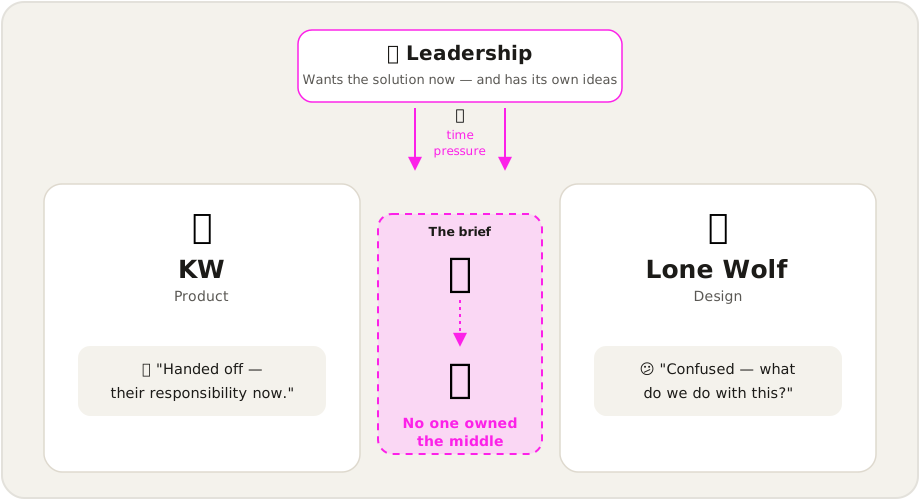
Contact Enrichment was one of the first projects run under a new arrangement: Keller Williams and Lone Wolf working as a single team through a managed-services model, for the first time, on tight timelines and with no shared playbook for how that collaboration was meant to work. The early going was confusing and rocky.
The initial product brief landed in the space between neither side clearly owned. The KW product manager treated the handoff to Lone Wolf as complete ("it was their responsibility now") while Lone Wolf was still working out what the brief meant and what they were supposed to do with it. At the same time, senior leadership was anxious to see what the solution would look like and had their own ideas about what it should be, pressing the team from above for an answer before the problem had been defined.
definition
The brief didn't need building, it needed defining
The product brief given to the development team was long, abstract, and — being AI-generated — full of possibility with no point of view: plenty on what contact enrichment could be, almost nothing on why it mattered or who it was for.
Distilling it required me going back through the existing sources, drafting the open questions the brief had skated past, and separating what was relatively well-defined from what we still needed to learn and parse through. I pulled my synthesis together into a summary deck which the cross-company team could reference. Ultimately, I developed a strategic problem statement that the team adopted as their north star.
problem statement
How might we give KW agents a complete picture of each contact — from basics like email and phone to real-estate signals like equity, time in home, and life events — so agents know who to call (prioritize), why to call (timing & relevance), and what to say (context & narrative)?
The problem statement defined the why behind the project, specifying the user needs and the reason this initiative mattered. It steered the team from the sprawling, open-ended product brief into something focused and concrete that we could design against.
Summary Deck

My summary deck distilled the research review, open questions, and known/unknown split into the path forward
convergence
I made the opportunity set decidable
I had defined the strategic problem statement, but it was not a solution the team could yet build against. We still had no agreement on which enrichments mattered, or in what order.
To answer that, I ran a journey-mapping workshop designed to do one specific job: surface a set of ideas grounded in what agents actually needed, rather than a feature list assembled from opinions in a room. I brought the whole cross-company team into two persona journeys and had them map what agents and team leaders were doing, struggling with, and needing at each stage. Afterwards, I synthesized the results into eight job-stories framed as Doing, Struggling, and Need.
user journey workshop

The Miro journey-mapping board, with two persona journeys, resulted in an solution idea set that was grounded in user needs
But I did not stop there. The outputs from the workshop (user-grounded idea set) fed an effort x impact matrix that sequenced the opportunities into what could ship first and what could come later. That prioritization made the brief decidable. The abstract "what do we even do here" became an ordered, defensible backlog — something the team could commit to and which Lone Wolf could pick up and execute.
impact x effort matrix

Inputs from the user journey mapping fed this exercise and resulted in a prioritized solution set
concepts
I delivered conceptual designs to solidify the alignment
A problem statement and a solution priority list told the team who we were building for and what to build first — but they were still words on a page. For two companies that read the brief differently, with leadership pressing to see it, words weren't enough. So I made the direction tangible: I built solution-shaped concepts of what the enriched contact card could actually look like.
The feature set was sprawling, so I didn't try to show all of it. I focused the concepts on the crux of the solution: how the enriched data would surface on the contact card. It was the clearest thing to make concrete, and it pulled the team onto the meat of the experience instead of the edges.
rapid concepts


Three Claude-built concepts, rapidly created to provide visuals for the team to align around the same direction
Delivering rapid designs before requirements carries the risk of anchoring the team to that specific solution shape. I had to ensure that the concepts were received as such. I leveraged Claude to turn around the design quickly and kept it off Figma to signal that it was not a formal, dev-ready handoff file. Additionally, providing different options made the concepts more tentative (as they were) and presented them as ideas to consider, not recommendations to approve.
impact
A defined problem and direction for development
Once the problem was defined and the opportunities sequenced, the team could finally write against it. Lone Wolf understood what they were building and why, and the work moved out of open-ended discussion into a written PRD and a scoped build. Senior leadership, which had been pressing for a solution, was satisfied with having something to point to. A Lone Wolf designer took over the project's design execution, inheriting a defined problem and a prioritized backlog rather than the sprawling brief I had started from — a springboard instead of a vast, empty canvas.
the before & after
01
A sprawling brief became a concrete PRD
An abstract, AI-generated brief became a written product spec the team could build against.
02
A fractured cross-company team became aligned
Two companies that had read the brief in all different ways converged on one direction.
03
A blank canvas became a springboard
I handed off a defined problem and sequenced solution set, not the abstraction we started from
reflection
The bulk of the design work was upstream
Contact Enrichment reinforced one of the tenets of my work: the most valuable design work is often the strategy and definition itself, not the interface. However, the timeline was the single largest struggle of the project. It was one of the first initiatives the two companies ran together under a new working model, and there were only about three weeks between the project being named an initiative and the start of the quarter, when the requirements had to be completed. Defining a sprawling brief that fast, across two companies that had never worked together, was a real constraint on the work.
let's figure it out
If you've got a problem, I'd love to hear about it
Here to help when you're not quite sure what to build yet.

Huyen Bui
·
Product designer
·
2026
Los Angeles, CA
·
Set in pastels