Automations
keller williams
·
Command (Enterprise CRM)
Driving product roadmap with UCD
Leveraging UCD to collaboratively craft a tangible product roadmap for delivering broad-scale automation functionality on a CRM platform
role
Product Designer
Team designer, cross-functional collaboration, stakeholder communication
product
Command
Proprietary enterprise CRM for Keller Williams agents
timeline
2023
A quarter to set the strategy that informed future roadmap
context
The ask to bring competitive parity
Command is Keller Williams’s end-to-end real estate technology platform, made to empower agents with CRM tools and resources to streamline their business operations. In order to achieve a best-in-class position, Command needs to keep pace with competitors and incorporate automation capabilities.
Though the team was tasked with exploring automation broadly across the entire platform, our first focus was around transaction management. Transaction management refers to the real estate agent’s workflow around selling or buying real estate--a critical domain in the real estate business.
problem statement
How might we bring competitive automation features to transaction management?
Because of my strong track record as a strategy-driven designer on Command, I was placed on the automation task force to determine how we could deliver automation capabilities for the platform. My contribution to the team included:
Project Management & Strategy
Establishing a process forward through ambiguity
Cutting through the noise and complexities to discern the most critical decision points
Collaborating with product, engineering, research and other designers to develop a product roadmap
User Research
Determining open questions and knowledge gaps
Planning and conducting user interviews to establish foundational understanding of users
Analyzing user needs
Design
Competitive analysis of automation features
Rapidly wireframing visuals to aid in planning discussions
Crafting visual story decks to communicate complex information and persuade stakeholders of recommendations
process
An iterative and collaborative cycle
The project was particularly challenging because of its broad scope and our lack of a pre-existing knowledge base. Drawing from my user-centered design expertise, I proactively formulated and advocated for a path forward that focused on filling in our knowledge gaps before ideating any solutions. The result was an iterative and collaborative process towards creating a well-defined product roadmap.
Iterative Understanding + Strategizing Loops

Steps decreased ambiguity over the course of the program
understand to explore
Gathering foundational knowledge first
The initiative was the broadest ask any of us had encountered. Furthermore, we had little to no comprehensive user research to support our decision-making in this domain. To work through the ambiguity, I proposed that we first needed thorough answers to some basic questions:
What is the user workflow around transaction management? Approach: User Interviews
What automation features do we need to be in parity with competitors? Approach: Competitive Analysis
User Interviews: Transaction Workflow
Our research repository lacked foundational knowledge around the transaction management process. We sought to gather this knowledge by conducting user interviews to answer the following research questions:
Understand users’ mental models of the transaction process and how those models influence their transaction management.
Understand the systems (including top competitors) that agents currently use for transaction management, including tasks and communications.
Identify which actions agents would prefer to automate/where they can save time.
We interviewed seven participants who all directly performed transaction management work. Our research uncovered a wealth of insights that both proved and disproved existing assumptions. Most importantly, the research allowed us to develop a detailed work flow mapping, bringing much-needed clarity on our subject matter.
transaction workflow mapping

The output of our extensive user interviews was a detailed mapping of the real estate transaction workflow
Competitive Analysis
Referencing previous analyses, subject-matter knowledge and the demos that some of our participants gave during user interviews, we performed a competitive analysis across three different competitors. We compared the platforms’ transaction management functionality to Command based on their features and automation capabilities.
This analysis provided us with a preliminary feature set that allowed us to start strategizing.
feature set analysis

Competitive analysis showed us what the expectation was from stakeholders
understand to refine
Utilizing wireframes to evaluate against user needs
Wireframes
Once we had a preliminary feature set and some implementation options, I found it necessary to visualize them in low-fidelity wireframes. Engineering helped provide feedback about the feasibility of the wireframes, allowing design to iterate them as necessary.
The wireframes helped us have concrete discussions around both the experience and technical considerations, as well as highlighting more open questions.
wireframes
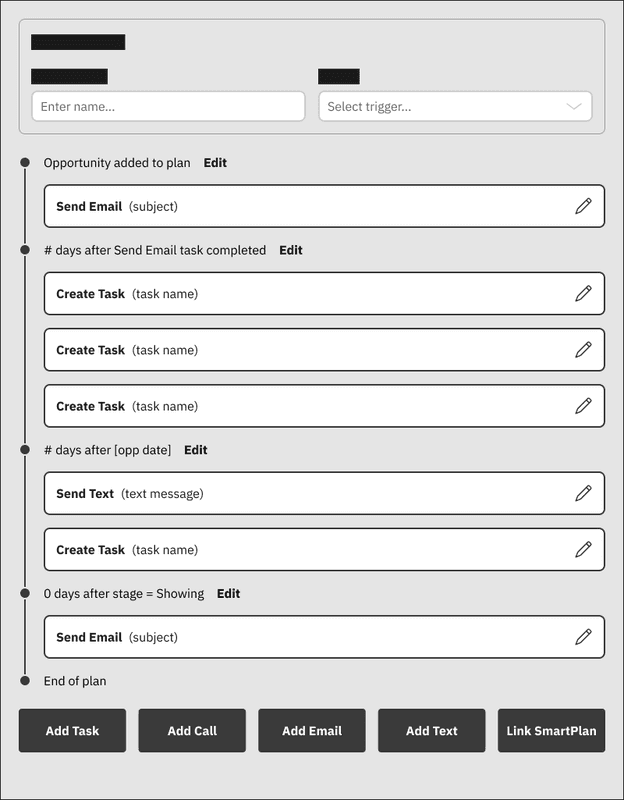


Three solution approaches, presented in low-fidelity for reactions & discussion
Use-Case Analysis
Using the wireframes, I performed a use-case analysis to gauge the validity of our feature set. In order to ground the team in actual data from the user interviews, I performed the analysis from the point of view of each persona, voicing their use case against our wireframes:
user needs: solo agent
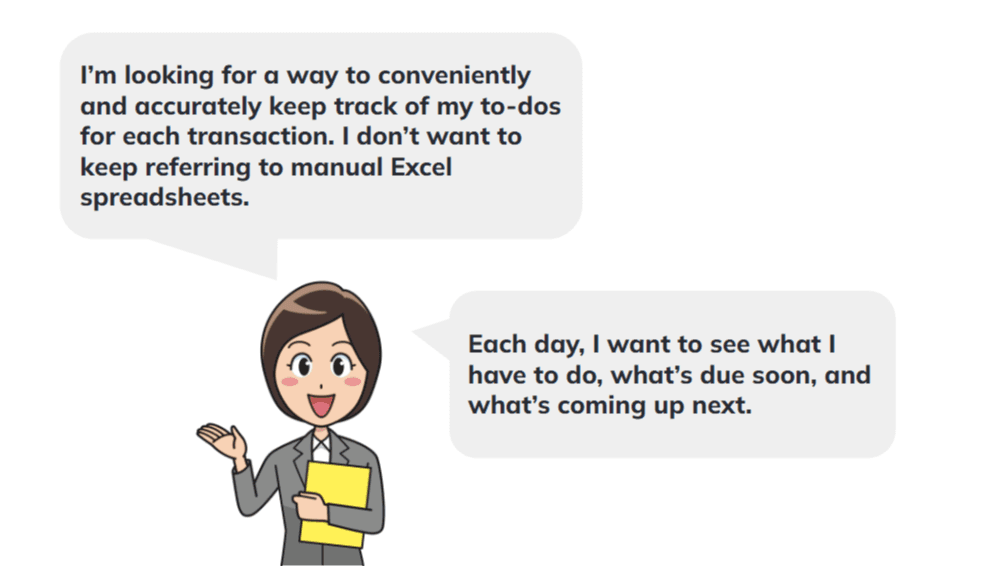
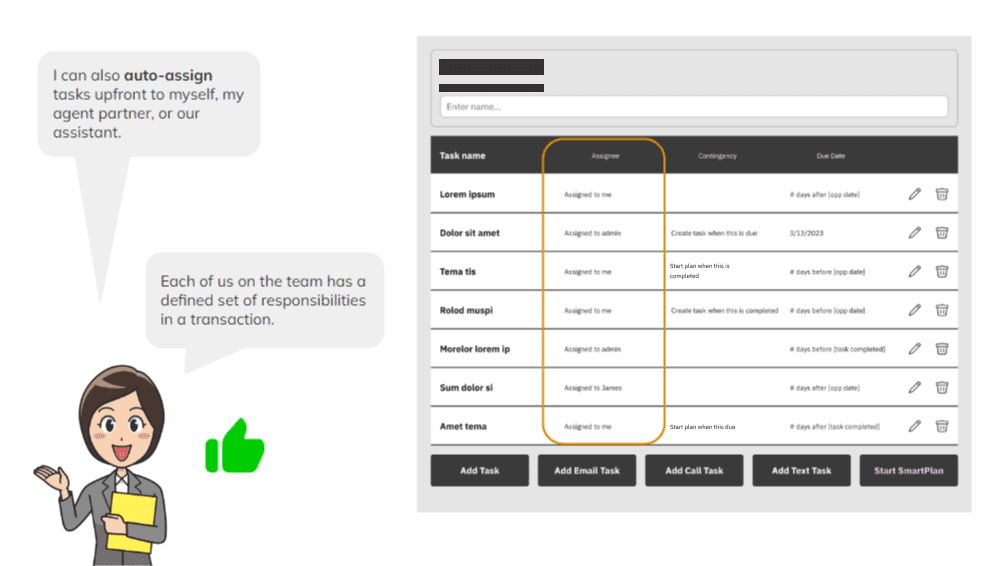
Solo agents want to be more organized in their transaction to-dos
user needs: team agent


Team agents could find that some of our planned features don't make sense for him
This analysis incentivized us to rethink our feature set and implementation plan. More importantly, it also revealed our knowledge gaps about how high-volume teams have different needs than regular agents and might require more automation.
User Interviews: Use-Case Validation
Because my use-case analysis indicated we did not fully understand our high-volume teams persona, we aimed to talk to this user group to further validate our use-case hypotheses. Our stakeholders were also particularly keen on hearing from these teams specifically.
We interviewed seven participants over four teams and focused specifically on the following areas:
Identify which actions agents would prefer to automate/where they can save time
Understand the systems (includes top competitors) that agents currently use for transaction management, including tasks and communications
Originally, our subject-matter experts hypothesized that agents would require robust automation capabilities which would allow them to create complex workflows around dynamic triggers and actions. Surprisingly, both regular agents and high-volume teams explicitly denied their need for this type of complex automation. In fact, the user groups offered conflicting assumptions about each other:

Iterative & Collaborative Strategizing
A robust, all-hands-on-deck loop
While the user research, competitive analysis and related syntheses were owned by research and design, converting those results into product strategy was a collaborative effort with product and engineering.

The process was an iterative cycle of defining the feature set, discussing how to implement the features based on the platform’s infrastructure, developing a roadmap with timelines to get the development done and refining everything as we gained additional information from our “Understand” stages.
Feature Set
Originally, we were tasked with implementing "workflow automation" features, as derived directly from one specific competitor. However, by developing an understanding of real user needs, we discovered that the right solution involved bringing automation to our existing tasks experience, rather than creating extensive automation around workflows.
determined feature set

Our updated feature set was much more grounded in real user needs
Implementation Options & Product Roadmap
Our stakeholders were initially locked into a solution of merely copying the workflow automation solution from a competitor. However, our research discovered that:
Having specific, task-related automation features fulfilled the competitive parity need and were enough to empower agents to streamline their transaction task management.
Users did not need or want powerful workflow automation capabilities that would make the whole process more complex. In fact, some agents intentionally avoided the automation features in our benchmark competitor.
Building out vast automation for workflows was a massive technical lift requiring half a year’s work. The ROI would not be worth the effort.
Though stakeholders were pushing for bringing complex and powerful automation upfront, through careful research, analysis and persuasion, my team was able to assure stakeholders of a different, but better path than their original intention.

We successfully validated automation features against user needs to persuade stakeholders of a solution that could bring more value with less resources
impact
Managing stakeholder expectations succeeded
Since our automation effort was a big driver behind Command being “best-in-class”, it was an extremely high-profile, high-stakes initiative. Even though we were originally handed a solution, I knew that committing to this without first understanding the landscape would be a mistake. Thankfully, we were allowed the time and resources to conduct a thorough investigation of the user needs and technical environment.
The success of the final product roadmap was also owed to a variety of slide decks I crafted during the process. My slide decks 1) clarified complex discussions; 2) allowed the team to focus on answering the right questions; and 3) convinced stakeholders to abandon their original solution in favor of our new strategy.
This was one of the best stakeholder meetings we've had, the team clearly knows what they're doing and we're very excited for what's to come.
Stakeholder feedback
You guys did such a good job visually communicating such a complex topic. It was easy to understand.
Stakeholder feedback
Our accomplishments lend credibility to the UCD process in an environment where the UX organization was still looking to establish UCD best practices. Most importantly, I was able to prove the success of extensive foundational UX research, further paving the way for integration of proper UXR processes in the product development cycle.
With our roadmap defined, the team has a path forward to developing the first few automation features for Command’s transaction management tool. With a foundational understanding of the domain, we can proceed with confidence that we are building the right solution.
let's figure it out
If you've got a problem, I'd love to hear about it
Here to help when you're not quite sure what to build yet.

Huyen Bui
·
Product designer
·
2026
Los Angeles, CA
·
Set in pastels